The Mechanics Grove Farmhouse of Horror
 |
| Doc Zimmerly's farmhouse in Mechanics Grove |
Situated in East Drumore Township, Lancaster County, is the rural village of Mechanics Grove. While its unclear when this village, just south of Quarryville, sprang into being, there are mentions of Mechanics Grove in Lancaster newspapers as early as 1847, and the 1864 Bridgens' Atlas of Lancaster County shows the village as a cluster of a dozen or so homes, shops and businesses. While it may seem strange that a tiny farming community devoid of factories should be named Mechanics Grove, at the time of its founding, the word "mechanic" was used to describe any type of tradesperson, from basket weavers to carriage builders.
For most of its history, Mechanics Grove was a quiet, unassuming community amid the rolling farmlands, but things changed in 1935, when authorities uncovered a supposedly haunted "house of horror" owned by a disreputable physician known as as Doc Zimmerly.
Born in Beaver County in 1868, Harry Clifford Zimmerly graduated from the Cleveland University of Medicine and Surgery in 1894 before settling in Pittsburgh, where he married his first wife, the former Etta Bond. Together, they had five children. Not much is known about the medical practice he conducted in the Hazelwood neighborhood of the city, but Dr. Zimmerly was active in politics as a young man, becoming a member of the Democrat city committee. In fact, in 1908, he was an alternate delegate to the Democratic National Convention. The following year, he ran an unsuccessful campaign for a seat on the council for the city's newly-created Fifteenth Ward.
By 1914, Dr. Zimmerly had left both Pittsburgh and his family behind, and relocated to Philadelphia. He struggled to build a practice in the city, however, and the following year he went to Nottingham, Chester County, to take over the practice of Dr. S.L. Anderson, who was preparing to move his family to the West Coast. It was at this time the physician moved into the old Mechanics Grove farmhouse which would forever cement his name in infamy.
By all accounts, it seems that Doc Zimmerly ran Dr. Anderson's practice into the ground, most likely on account of his heavy drinking. In 1917, he was arrested for driving under the influence, after crashing his car into a wagon and a team of horses driven by an East Nottingham farmer. The farmer found Zimmerly inside the crashed car, drunk as a skunk, with a gallon jug of whiskey by his side. Life threw him another curveball in September of 1918, when his oldest son, Henry, died suddenly in Pittsburgh at the age of 17 after being struck by a car while riding a bicycle.

Doc's Farmhouse Hospital
Now in his middle age and separated from his wife and children, Zimmerly decided to convert a portion of the old farmhouse into a private hospital. As the old farmhouse had long been rumored by locals to be haunted, Doc's plans did little to make the property less creepy to the locals-- especially since it was rare to see patients enter and leave the building.
The true nature of Doc Zimmerly's secret private hospital first came to light in August, 1919, after he was arrested for having a peculiar relationship with his teenaged housekeeper, Mary Hanna. Zimmerly had long been believed to be an abortionist; in fact, after Mechanics Grove citizens had tried to run him out of their village, Zimmerly erected a 13-foot-tall "spite fence" around the farmhouse to keep out inquisitive neighbors. Despite gossip and rumors, there was never any concrete proof that Doc Zimmerly had been performing illegal operations-- until Mary Hanna came forward with her story.
As the district attorney wrote in his charging document:
The county will show that this man made Mary Hanna a slave for four years in his home in Mechanic's Grove. The girl has been his actual slave since she was fourteen years old. She is now eighteen. According to her story, seconded by neighbors, she has been subjected to about every immoral practice on the criminal calendar.
Doc Zimmerly was charged with statutory rape, abortion, holding a girl for immoral purposes, adultery, and seduction of a minor. He went on trial before Judge Landis on September 13, 1919. Mary's testimony revealed that Dr. Zimmerly had promised to marry the teenager, but never fulfilled his promise. Zimmerly emphatically denied the accusations against him, and claimed that the charges had been brought as revenge by Mary's parents. Nonetheless, he was promptly convicted, but only on the abortion charge-- the prosecution agreed to drop the rape charge. In January he would receive his sentence from Judge Landis: one year in prison.
Three days later, on September 16, Doc Zimmerly was arrested again, on a charge of non-support of his estranged wife. Later that day, he was also involved in another serious accident, when his car overturned on Church Street in Quarryville. It is unclear whether or not he was drunk at the time. In January of 1920, he would receive his sentence from Judge Landis for the abortion conviction: one year in the county prison. He applied for a pardon, but was denied, leaving the women of Lancaster County scrambling for a new abortion provider.

The Doctor's Demons
Doc Zimmerly was released from jail on November 24, 1920. It wasn't long before things began looking up for him; in 1922, he married Viola Pepper, who was twenty-one years his junior, and he began to cultivate a reputation as a trustworthy country doctor. But tragedy once again struck in May of 1924, when Mr. and Mrs. Zimmerly lost their four-month-old-son, Henry Joseph, to an unspecified illness. He returned to his heavy drinking, and was arrested in 1926 for public drunkenness and disorderly conduct.
It seems that Viola's patience with her husband's alcoholism soon ran out. In January of 1927 she abandoned him, taking their 16-month-old daughter, Zita, with her. Four months later, Doc Zimmerly would overturn his car yet again, this time near Refton. He was arrested and charged with driving while intoxicated. When a judge ordered Zimmerly to pay support to Viola and their daughter in the amount of $12.50 per week, he wasn't able to meet his financial obligations, and successfully appealed to have the amount reduced to six dollars per week. Facing the Great Depression with a dwindling practice, a thirst for whiskey and an uncertain financial future, Dr. Harry Clifford Zimmerly was forced to apply for government assistance. He also returned to performing illegal operations.
 |
| Doc Zimmerly's "spite fence". |
Doctor Sticky Fingers
In March of 1935, a 26-year-old woman from Calvert, Maryland, named Gladys Lawson was reported missing by her family. When Gladys, a mother of two, was last seen, she was a patient at Doc Zimmerly's farmhouse hospital. It was her sister, Mrs. George Crawford, was visited her in Mechanics Grove on March 13-- the last day she was seen alive. "Gladys was in bed and appeared to be in great misery," her sister recalled. "I asked her when she would be able to go home and she replied, 'God knows when'." According to her family, she was wearing a green coat, a blue silk dress, brown gloves and black pumps when she left her home in Calvert.
For two weeks Mrs. Crawford bombarded Zimmerly with phone calls inquiring about Gladys, but the 67-year-old physician refused to divulge any information. When Mrs. Crawford traveled to Mechanics Grove to confront Zimmerly in person, Doc responded by threatening her with a shotgun. It was then she decided to report Gladys as missing.
On Wednesday, April 3, the farmhouse hospital was raided by County Detective Jacob Weller, Sergeant Ray Simmons of the State Police, and Constable W.G. Sweigart. They didn't find Gladys, but inside Zimmerly's office they found the clothes she had been wearing when she left home.
 |
| Gladys Lawson |
At the time of the raid, Dr. Zimmerly was at the bedside of another patient, 17-year-old Elsie Miller of Rising Sun, Maryland. The girl's mother, Fay Miller, was at the Zimmerly farmhouse at the time, and was taken into custody and held as a material witness after admitting to police that Elsie had been subjected to three operations by Zimmerly since their arrival one week earlier. It was obvious to the police that Elsie was in a very sick condition. After placing Zimmerly under arrest, Elsie was rushed to Lancaster General Hospital on the order of District Attorney Paul A. Mueller.
Under questioning at his home, Zimmerly gave rambling, incoherent statements concerning the whereabouts of Gladys Lawson, leading Detective Weller to conclude that the old country physician was under the influence of narcotics. "He was under the influence of something," said Weller. "I did not detect any odor of liquor on his breath."
The doctor admitted that Gladys was one of his patients, but insisted that he had driven her to Lancaster on Saturday, March 16, and that was the last he had seen of her. Also questioned was a friend of Gladys Lawson, a waitress by the name of Beatrice Reynolds Trimble. Beatrice told police that she had returned Gladys' jewelry to the Lawsons for safekeeping at her request. Gladys told Beatrice that she had caught Doc Zimmerly going through her purse and was convinced that he planned to rob her.
 |
| Blanche Stone |
Farmhouse of Horrors
Blanche Stone, a former nurse and housekeeper for Doc Zimmerly, came forward and told authorities that Gladys Lawson had died during a botched operation on March 16. She wasn't sure what Zimmerly had done with the body, but she insisted that it was gone from the farmhouse when she showed up for work early the next morning. Authorities made a thorough search of the Zimmerly property, but concluded that the doctor had buried Gladys in a different location.
Dozens of locals were also interviewed by authorities. They recalled hearing blood-curdling shrieks and groans coming from the secretive farmhouse hospital. They also told police that a car would often come roaring out of the doctor's garage at any hour of the day or night, often not returning for a day or two. Where Doc was going in such a hurry, no one could say for sure.
 |
| County Detective Weller with clothing belonging to Gladys Lawson |
While detectives searched for the remains of Gladys Lawson, Doc Zimmerly was charged with two counts of performing an illegal operation and held on $6,000 bail. Newspaper reporters, quite naturally, were eager to catch a glimpse of Doc Zimmerly's operating room and living quarters. They were appalled at what they encountered. The cellar of the farmhouse was filled with barrels and jugs of whiskey; Doc's kitchen sink was filled with dirty dishes, while blood-stained work clothes, empty bottles and books littered the floors of his bedroom and living room. Federal agents were called to the scene after large quantities of narcotics were found in Zimmerly's office, where reporters also saw the butt of a shotgun sticking out from a heap of dirty quilts and empty chloroform bottles haphazardly tossed onto the floor.
The "hospital" was just as filthy and unhygienic as Zimmerly's living space: Filthy rags were draped over chairs, surgical instruments were carelessly stuffed into a desk drawer, and a saliva-spattered spittoon full of tobacco spit stood right next to the operating table, which, according to one newspaper, was nothing more than a broken-down reclining chair covered with soiled quilts and blankets.
 |
| Unidentified investigator examining Zimmerly's operating table. |
Some reporters weren't surprised that so many of Doc Zimmerly's patients suffered post-surgical complications. They were more surprised that any of his patients survived at all. "The place might well have been wrought by fiend or witch in demoniacal travesty upon the spotless operating room of modern science," wrote the Lancaster New Era.
On the morning of Saturday, April 6, 1935, Doc Zimmerly was held for court after being unable to post bail, which by now had increased to $10,500 thanks to his reckless violation of federal narcotics laws. At the bail hearing, which was held before Alderman John F. Burkhart, the doctor's former nurse, Blanche Stone, testified about the death of Gladys Lawson.
"On Friday, March 15, at 6 p.m. Gladys Lawson called for me," stated Miss Stone. "She was lying there in bed, moaning, gasping for breath and spitting blood. She looked like she was dying. I couldn't stand it up there, so I went downstairs into the front room. I was right under the bedroom in which the Lawson girl was, and I could hear her moaning. At 12:30 a.m. on March 16, the moaning stopped. Doctor Zimmerly came downstairs. He said, 'She's gone'."
Blanche Stone then described how, later that morning, Zimmerly left the house in his green coupe, proceeding south. According to Miss Stone, he returned four hours later and made her promise to tell anyone who asked that he had driven Gladys to Lancaster, which was in a completely different direction.
Things went from bad to worse for Zimmerly just a few hours later, when authorities found pieces of bone on the disgraced doctor's property.

The Bootlegger's Story
County Detective Weller tracked down a friend of Doc Zimmerly, a 32-year-old liquor bootlegger named Richard Parker, whose name had been provided to authorities by an anonymous source. When questioned by Detective Weller, Parker, who worked for the doctor as a handyman, admitted that he had sharpened the doctor's butcher knives before watching through a window as Zimmerly dismembered Gladys Lawson on the second floor of his garage.
"She's dead," declared the bootlegger to Sergeant Ray Simmons, as he puffed nervously on a cigarette. "I didn't see her die, but I know she's dead. I believe I can show you where he put the body."
Parker denied participating in the dismemberment of the deceased patient, but hinted that there may have been more than one victim. "I didn't have anything to do with it," he continued, "but I smelled chemicals and burning flesh. I will show you the place and you may find the body-- maybe bodies." Parker also described Doc Zimmerly as an opium addict, and Doc had even assisted him in rum-running when he needed to earn extra money. Doc emphatically denied being a drug addict, but admitted that he occasionally used cocaine for "sinus trouble".
 |
| Constable Sweigart and Blanche Stone search for bone fragments |
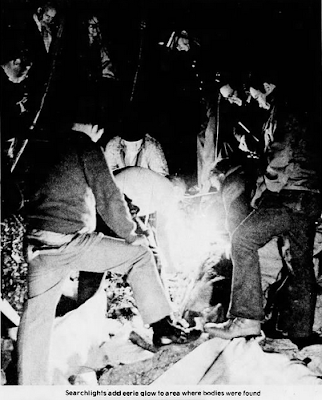
A large crowd of officials, reporters and curious neighbors soon descended upon the property on the afternoon of April 6. Led by District Attorney Mueller, the team included city chemist Dr. J.E. Goodell, Constable Sweigart, and Miss Blanche Stone. They tore away part of a wall that the doctor had recently constructed and found bloodstains, while County Detective Weller found bits of bone in the ashes Doc Zimmerly had used to cover the driveway in front of his garage. Soon, he had found enough bone fragments to fill a cigar box. One large chunk of bone was from a jaw, and it still held part of a tooth.
"There is little doubt that these bones are those of a human skeleton," declared Dr. Goodell, though he stopped short of stating that Gladys Lawson had been found at last. Detective Weller, on the other hand, considered the case closed.
"I guess we got her," he said to reporters.
Later that evening, Major C.M. Wilhelm, assistant superintendent of the Pennsylvania State Police, announced from Harrisburg that the State Police Homicide Squad would be dispatched to Mechanics Grove to assist District Attorney Mueller in the investigation. Lieutenant Harry McElroy soon arrived on the scene, accompanied by a handful of forensic experts. Among the evidence they gathered was a bloodstained wire and tins packed with an unknown waxy substance which Detective Weller wondered might be human fat. Meanwhile, Dr. Louisa Keasbey, a pathologist at Lancaster General Hospital, was given the cigar box of bone fragments for analysis.
 |
| Gladys Lawson with her brother, Grover, and her children Rondall and Ruby. |
Thousands Trample Crime Scene
By Monday, the Zimmerly property had been overrun by thousands of souvenir and relic hunters, much to the frustration of the lone state trooper who had been assigned to keep curiosity seekers at bay. According to the Lancaster Intelligencer-Journal, traffic through the village of Mechanics Grove was "thicker there than in Lancaster on a market day", while hundreds of cars were parked near the farmhouse at the intersection of Church Road, Spring Valley Road, and the Robert Fulton Highway.
The frenzy only intensified after authorities stated that up to four patients may have vanished after receiving "treatment" at the farmhouse hospital. A few souvenir hunters actually succeeded in finding bone fragments on the property, including one man from Maryland named Lawson (no relation to the victim) who was certain that he had uncovered a human finger. Unfortunately for the morbid sightseers, Dr. Keasbey announced on April 8 that most of the bones had come from chickens and rabbits. Other fragments, however, were burnt so badly that she had been unable to identify them at all.
The search for Gladys Lawson continued, both in Pennsylvania and Maryland. Major Lynn G. Adams, State Police Superintendent, expressed his belief that her body was indeed cut to pieces and burned, but doubted that any human remains would be found on the Zimmerly property. His only hope was that Doc Zimmerly would break his silence, but he never did.

The Investigation Continues, Then Stalls
In mid-April, it was announced that a search of the furnace in Doc Zimmerly's garage yielded more bone fragments, but authorities weren't as quick to jump the gun this time. Yet there was an interesting detail pointed out by State Police Homicide Detective William A. Miller: In March, Zimmerly had ordered a large quantity of firewood, and all of it had disappeared-- even though the weather that month had been mild and unseasonably warm.
As for the dying teenager who had been rescued from the farmhouse hospital, Elsie Miller, her condition improved and she seemed well on her way to recovery. On the other hand, another important witness, bootlegger Richard Parker, was admitted to St. Joseph's Hospital for treatment for his drug addiction. Battling symptoms of withdrawal with his supplier locked up in the county jail, Parker's statements to detectives became erratic and nonsensical. Every few days he seemed to have a revelation about where Zimmerly had disposed of the bodies, sending authorities on wild goose chases throughout Pennsylvania and Maryland. But then Parker escaped from the hospital, stole a milk truck, and fled Lancaster. He was later found at Zimmerly's home, desperately searching for narcotics.
Also complicating matters was the fact that two key members of the investigation-- Dr. Keasbey and Sergeant Simmons-- were both on vacation. As a result, all of Lancaster County waited with bated breath to learn if the furnace bone fragments were human in origin.
 |
| Bootlegger and handyman Richard Parker |
A Breakthrough at Last
On Monday, April 22, District Attorney Mueller announced that the bones found in the furnace were indeed those of Gladys Lawson. This determination had been made by Dr. J.W. Rice of Bucknell University, who positively identified the fragments as those of a young Caucasian female's skull, ribs, spine and arms. Many of the bone fragments bore tell-tale signs of being cut with a saw.
The district attorney, however, concluded his conference by stating that the Commonwealth would not pursue any additional charges against Doc Zimmerly beyond the two counts of performing an illegal operation (in addition to the five federal drug charges), as there was no way to prove that Gladys had been murdered.
After failing to find any trace of the other female patients who supposedly vanished after visiting Mechanics Grove, the state police tried to convince Doc Zimmerly to submit to a truth serum test. "The doctor was rather amused at the idea at first," said Zimmerly's attorney, B. F. Davis. "He had never heard of it before and wanted to know what it was all about. He finally dismissed it by telling the state police to go to hell."
 |
| Zimmerly attempting to hide his face as he enters courthouse. |
The Trial of Doc Zimmerly
On June 10, 1935, Harry Clifford Zimmerly was indicted on eight counts by a grand jury, despite one of the Commonwealth's star witnesses, Richard Parker, going on a jailhouse rampage earlier that morning. Parker had torn up his cell, raving like a madman, refusing to change out of his prison garb and testify in court. Zimmerly's handyman had to be forcibly carried out of the jail and into the courtroom.
After securing the indictment, District Attorney Paul Mueller requested an immediate trial, and a jury was selected later that afternoon. But things hit a snag when one of the jurors, Mrs. Hettie Grassel, became ill and collapsed after the prosecution presented as evidence a box of bloody rags found at the farmhouse hospital. Judge Benjamin C. Atlee declared a mistrial, a new jury was promptly chosen, and testimony resumed.
 |
| Left: Gladys' sister, Clara Crawford. Center: Parker being carried out of jail. Right: Nurse Blanche Stone. |
More than twenty witnesses were called to testify. One of the witnesses, Arthur Smith, was the man who had driven Gladys Lawson from Maryland to Mechanics Grove. According to Smith, Doc Zimmerly had made a surprise visit to him in Maryland, and Doc had declared, "She died last night and I've got the body on my hands and I've got to get rid of it." During the trial, District Attorney Mueller also revealed that an analysis of the greasy substance found in cans in Doc's cellar was human flesh.
On the second day of the trial, Zimmerly's handyman, Richard Parker, broke under tough questioning. Parker, who had insisted that he had played no role in the disposal of the body, admitted that he helped carry Gladys Lawson's corpse into the garage where it would be "dissected" by his employer. He also admitted to administering drugs to Gladys, under Doc's direction, as she lay in bed in a dying condition.
"What drugs did you administer?" asked the district attorney.
"The doctor called it 'twilight sleep'," replied Parker.
 |
| Pathologist Dr. John W. Rice |
Zimmerly's counsel, in an attempt to prevent things going from bad to worse, did not offer a defense. On Thursday, June 13, Sumner V. Hosterman of the defense team made his closing argument. He essentially admitted his client's guilt, but wondered why Doc was the "fall guy" for a corrupt system that allowed such operations to take place.
"In Pennsylvania, abortion is a high crime. A felony and a high crime to the doctor who does this sort of thing-- but equally a high crime and a felony to those who aid and abet in this sort of thing," he stated.
"Who are the higher-ups in this case? We are charged alone, and those who have aided and abetted are let to go free. Old Doc Zimmerly alone is here to pay the penalty for what the Commonwealth alleges has taken place.
"Who are the higher-ups? One accomplice is Beatrice Reynolds Trimble... who Gladys Lawson had drive her up in her car to Zimmerly's... Arthur Smith, a farmer, unmarried, of Rising Sun, is the second accomplice... and it is a reasonable conclusion that they intended on getting married."
On the evening of June 13, the jury reached a verdict, finding Doc Zimmerly guilty on two of three counts. He was convicted of performing an illegal operation and performing an abortion resulting in the death of Gladys Lawson, but acquitted of the charge of performing an abortion resulting in the death of a child. He was sentenced to seven and a half to fifteen years at Eastern Penitentiary.
 |
| Doc Zimmerly leaving Lancaster County Prison |
The Death of Doc Zimmerly
On January 17, 1936, the Mechanics Grove "House of Horror" was sold at a sheriff's sale. Though it was reported that there was no shortage of interested buyers, the highest bidder on the notorious property was Joseph M. Pepper, father of Zimmerly's second wife, Viola. The property has changed hands several times over the years; it was once used as a poultry farm, and today it is a multi-unit residential property.
 |
| Doc Zimmerly's "house of horror" as it appears today. |
The fragments of bone found on the property were never claimed by Gladys Lawson's relatives. In January of 1936, these and other ghastly relics from the case did find a temporary home-- at the Farm Show Building in Harrisburg, where they were put on display by the State Police as part of an educational exhibit.
On August 29, 1942, Harry Clifford Zimmerly was found unresponsive inside his cell at Eastern Penitentiary, after suffering a stroke. Three days later he died from heart failure at the age of 74, with less than three months of his sentence left to serve. According to Prison Captain C.B. Haig, Zimmerly briefly regained consciousness before his heart stopped, just long enough to mutter two mysterious words: House... house.

Deputy Sheriff Robert Shuman leads Zimmerly out of courthouse.
It's unclear what Doc had meant with his dying words. Was it merely a desire to go back to the home he no longer owned? Or was he ready to divulge some deep, dark secret? Perhaps the fates of the other patients who had gone missing after subjecting themselves to surgery at the hands of a drunken dope fiend physician at an unsanitary farmhouse hospital?
Though the case of Doc Zimmerly and his farmhouse of horror created a nationwide sensation in 1935, there are undoubtedly many secrets Doc took to his grave, secrets that may never see the light of day.
Sources:
Cleveland Plain Dealer, March 21, 1894.
Pittsburgh Post, March 31, 1901.
Oxford Press, Jan. 28, 1915.
West Chester Daily Local News, Oct. 5, 1917.
Pittsburgh Post-Gazette, Sept. 15, 1918.
Lancaster Daily Intelligencer, Aug. 16, 1919.
Lancaster Examiner, Sept. 13, 1919.
Lancaster Daily Intelligencer, Sept. 16, 1919.
Lancaster Examiner, Sept. 17, 1919.
Lancaster Daily Intelligencer, Jan. 24, 1920.
Lancaster Daily Intelligencer, May 8, 1924.
Lancaster Sunday News, Jan. 23, 1927.
Lancaster News-Journal, June 7, 1927.
Lancaster Intelligencer-Journal, July 2, 1932.
Lancaster New Era, April 4, 1935.
Lancaster New Era, April 5, 1935.
Lancaster New Era, April 6, 1935.
Lancaster Sunday News, April 7, 1935.
Lancaster Intelligencer-Journal, April 8, 1935.
Lancaster New Era, April 8, 1935.
Lancaster Intelligencer-Journal, April 10, 1935.
Lancaster New Era, April 13, 1935.
Lancaster Intelligencer-Journal, April 15, 1935.
Lancaster New Era, April 22, 1935.
Lancaster New Era, May 4, 1935.
Lancaster New Era, June 4, 1935.
Lancaster New Era, June 10, 1935.
Lancaster New Era, June 11, 1935.
Lancaster New Era, June 12, 1935.
Lancaster New Era, June 13, 1935.
Lancaster Intelligencer-Journal, June 15, 1935.
Lancaster Intelligencer-Journal, Jan. 18, 1936.
Lancaster New Era, Jan. 25, 1936.
Lancaster Intelligencer-Journal, Sept. 3, 1942.

Comments
Post a Comment