The Unsolved Murder of the Schultz Children
 |
| Gail and Paul Schultz |
(Listen to the audio version here)
Around five o'clock on Saturday evening, March 7, 1953, a TV repairman was at work in his basement workshop, unaware that he was about to step into a nightmare more terrifying than any late-night horror flick that he or his customers had ever viewed on their television screen.
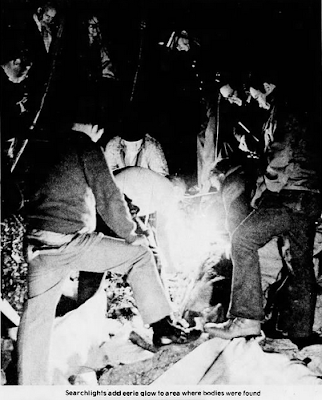
When Paul Schultz went upstairs in his home in Nazareth, his wife, Claire, asked him to go out and look for their two children, who hadn't been seen since two o'clock, when they left the house to look for rocks. There was little reason to worry; 18-year-old Gail was a responsible and intelligent girl, and her 12-year-old half-brother, Paul, Jr., though mentally handicapped, clung to Gail's side as though she were his own mother. The search for the Schultz children didn't take very long at all. Paul found his children in minutes. But, tragically, their bodies lay partially submerged in the shallow, ice-crusted stream behind their Mitchell Avenue home. It seemed that Gail and her brother had slipped on the snowy bank of Schoeneck Creek and had been unable to climb out.
Paul attempted mouth-to-mouth resuscitation while a neighbor, Robert Howells, called for help. The Nazareth Community Ambulance was the first to arrive, and the victims were taken to the firehouse where additional attempts were made to revive the two children, but to no avail. Gail and Paul, Jr., were prounced dead by family physician Dr. John Fraunfelder, who ruled that death had been caused by drowning. The bodies were turned over to John Katinis, a funeral director in nearby Easton, and the grieving parents set about the heart-rending task of burying their own children. But sorrow turned to horror when the Schultzes learned about the true nature of their children's deaths.
It was undertaker John Katinis who grew suspicious after noticing the head wounds on the bodies, which were initially believed to have been the result of slipping and falling on rocks. He notified the county coroner, Martin J. Bechtel, who immediately ordered an autopsy, which was performed the following day by Dr. Newton D. Larkum. The autopsy revealed that neither Gail nor Paul had enough water in ther lungs to cause drowning. The autopsy also revealed that both children had suffered skull fractures caused by a blunt instrument, presumably a hammer. Larkum believed that Gail had been struck seven times. A severely fractured thumb indicated that Gail had made an attempt to shield herself from the attacker. Paul had been struck three times in the back of the head.
While there was some consolation to be had from the fact that there was no evidence of a sexual assault, this detail left authorities baffled as to a motive for the senseless act.

Law Enforcement Perplexed
A tributary of Bushkill Creek, Schoeneck Creek's headwaters lie in the Eastlawn Gardens neighborhood of Nazareth, where the Schultz family resided. Characterized by modest single-family ranch homes and gently-curving streets, Eastlawn Gardens resembles any number of suburban neighborhoods which sprang to life during the post-war building boom of the early 1950s. Directly behind the Schultz home at 28 Mitchell Avenue now stands the Nazareth High School football field, which had not yet been constructed at the time of the 1953 double tragedy. At the time it was nothing more than a grassy field devoid of trees, providing a direct line of sight from tiny Schoeneck Creek to the back door of the Schultz residence.
That the Schultz children should meet such a violent end just two hundred yards away from their back porch-- in broad daylight on a Saturday afternoon-- perplexed authorities and the Schultzes to no end. There was nowhere for a killer to lie in wait for his or her victims, nowhere for the killer to hide after clubbing Paul and Gail to death. Anyone running away from the scene of the crime surely would've attracted the notice of one of the residents of Mitchell Avenue or Liberty Street, and no suspicious characters had been seen in the vicinity. Troopers from the Bethlehem barracks, under the direction of State Police Captain Charles S. Cook, were unable to find anything that could've been used as the murder weapon. It was if Paul and Gail had been murdered by a ghost.
Neither of the victims had carried with them anything of value. If robbery or lust wasn't the motive, then what was? Revenge? Paul Schultz didn't think so.
"We had no enemies, and I am sure the children had none," he stated.
Complicating matters was the fact that the crime scene had been thoroughly trampled by the dozens of medics, policemen and firemen who originally responded to the call under the assumption that the Schultz children had drowned. The killer had undoubtedly left his or her footprints in the snow, but the evidence had been obliterated.

Examining the Family
Believing that the killer might've been a person familiar with the victims, investigators sought to learn as much as they could about the Schultz family. Gail was a recent graduate of Nazareth High School, and was the daughter of Paul and his first wife, Alice Ramaley Schultz, who died in 1938 when Gail was just four years of age. She was described by friends as a quiet "homebody" type, who enjoyed drawing and painting. She wrote poetry, she played the ukulele. If there had been a romantic interest in her life, nobody knew but Gail. Paul George Schultz, Jr., known to us family as "Butchie", was autistic. He had never attended school, but Gail was devoted to him and always put her half-brother's needs above her own.
Born in Phillipsburg, New Jersey, but raised in Virginia, Paul Schultz, Sr. was a quiet, industrious man. A Navy veteran, Paul was employed as a draftsman at the Crayola factory in Easton, and supplemented his income by repairing televisions at his home. His second wife, the former Claire Burke, was a stay-at-home mother. They had been married for 14 years. Paul and Claire both voluntarily submitted to a battery of polygraph tests at the state police barracks to put to rest any suspicions that they may have played a role in the murders of their children.
Investigators determined that the last known person to see the Schultz children alive was a neighbor, William C. Brace, of 19 Mitchell Avenue. At around 2:15, Gail and Paul had visited the Brace home to see if William's son, "Chubby", could come out to play. Mr. Brace told the visitors that Chubby wasn't allowed to leave the house until he finished cleaning the basement. The only visitor to the Schultz home that day had been from the butcher.
 |
| Paul and Claire Schultz leaving home for interrogation by state police |
The Investigation
On Tuesday, March 10, a press conference was held by Capt. Cook and Assistant District Attorney Clinton Palmer following the coroner's inquest. Though no evidence supporting the theory had been uncovered, Capt. Cook told reporters, "We are working under the assumption that this crime was the work of a sex maniac."
Detectives focused their efforts on questioning every known sex offender in the area. By the end of their investigation, more than 120 persons of interest would be interviewed, but in the early stage of the investigation, great hopes were pinned on the story of an identified female neighbor, who claimed that she had seen two children matching Gail and Paul's description walking with an adult male along the railroad tracks not far from where the bodies were found. Unfortunately, this man was never located.
Facing a scarcity of clues, the state police turned to one of their best homicide investigators, Major William F. Hoffman, commander of Squadron 4 in Philadelphia. A noted expert, Hoffman authored several books on criminology and was responsible for a much-needed revision of the Pennsylvania Criminal Code. He arrived in Nazareth on March 11, and, after studying the crime scene, oversaw a thorough search for clues in a fifteen acre area. Also joining the investigation was Detective Sergeant Ben Lichty of the Harrisburg state police barracks, a seasoned pro who had cracked several murder cases across Pennsylvania. With the state police's best men on the case, it seemed that it was only a matter of time before the authorities hit paydirt.
Meanwhile, that same day, the bodies of Gail and Paul Schultz were laid to rest in the Northampton County Memorial Shrine in Palmer Township. Though the stiff breeze still held the iciness of winter in its breath, hundreds of sympathetic citizens braved the cold to pay their final respects. As the caskets were lowered into the grave, Mrs. Schultz collapsed and had to be carried from the cemetery to a waiting car.
 |
| Searching for clues along Schoeneck Creek |
Gail's Glasses Found
On March 14, Gail Schultz's glasses were found by County Detective Arthur Haring and State Trooper Harold Schaeffer, in a spot just 40 feet from where her body was discovered. While some viewed this as proof that the children were killed near the streambank, others suspected that the glasses may have been planted there to muddy the waters of the investigation. After all, the area along Schoeneck Creek had been extensively searched during the previous seven days by hundreds of volunteers and law enforcement officials. Had the snow concealed them? Or did the killer return to the spot where he had discarded the bodies of his victims?
"It is entirely possible the glasses fell off while the girl was being carried to the creek from some place other than the open field," said District Attorney Elias W. Spengler. "And it is entirely possible somebody deliberately planted the glasses there sometime after the slaying."
 |
| Coroner Bechtel (at desk) conducting the inquest |
Also found near at the bottom of the creek was a 3/4-inch chisel with a bright yellow handle. Detectives decided that it was too small to have inflicted the fatal wounds, and the lack of rust indicated that it hadn't been in the water for more than a few days.
As the investigation hit the ten day mark, confidence in identifying the killer grew weak. By now, more than 30 persons of interest had been questioned, but detectives were unable to glean any useful information. District Attorney Spengler announced that Paul and Claire Schultz had been cleared of suspicion, having completed yet another round of polygraph tests, this time under the supervision of two psychiatrists from Allentown State Hospital.
The Disinterested Spectator
On March 17, police apprehended a new suspect in the slaying of the Schultz children. Willis Keck, a 38-year-old bachelor who lived with his invalid father two doors down from the Schultzes, was taken into custody at his place of employment, Nazareth Fabricators, where he worked as a drill press operator. Keck was held overnight and subjected to a severe grilling, as well as a lie detector test, at the hands of Detective William L. Nevin of the state police.
Keck passed the polygraph examination with flying colors and was eventually released. According to the state police, Keck, whose kitchen window provided a direct line of sight to the crime scene, had aroused suspicion because he was one of the few neighbors who didn't show much interest when Gail and Paul's bodies were fished out of Schoeneck Creek. While the rest of the neighborhood gathered around the flashing strobe lights of emergency vehicles, Keck remained inside his house, preparing dinner. He then took a bath and watched television, completely disinterested in the Schultz family tragedy.
Asked whether he knew what was taking place outside his home, he admitted that he saw a body being placed into an ambulance, but had no desire to discover the cause of the excitement. Though he had been neighbors with the Schultzes for over a year, he did not know the names of the children. In fact, he had never spoken to them. Helping Keck's argument was the fact that he had only run afoul of the law one time in his entire life: eight years earlier he had received a citation in Stroudsburg for a minor traffic violation. On March 19, Capt. Cook reported that Willis Keck was no longer a person of interest and he was released.
In addition to Willis Keck, authorities also questioned former neighbors of the Schultzes when they lived in Easton fourteen years earlier, as well as Gail's former teachers and classmates from Nazareth High School. meanwhile, Northampton County commissioners offered a $1,000 reward for information leading to the arrest and conviction of Paul and Gail's killer.

The Man in Tan
As the authorities had hoped, the reward offer caused tips to flood in, and each tip was given thorough consideration by the team working on the case. By this time, the investigation team included state troopers Harold Schaffer, Michael Wargo, Thomas Jenkins, and George Gollub; state police detectives Ben Lichty, Roy Wollendorf and Jack Mitchell; and county detectives Arthur Haring and Anthony Jirolanio.
After two weeks of wrong turns and dead ends, the most promising lead in the history of the case came in-- and the same person of interest was reported by not one, but several individuals. It was a railroader who first reported that he had seen a man in a tan topcoat walking the tracks near Eastlawn Gardens at around two o'clock on the afternoon of March 7, about the same time that the Schultz children left their home. Two other train crews, as well as an employee of the Hercules Powder Company, had also seen the same mysterious trackwalker. Additional witnesses said they saw another man in the field near Schoeneck Creek, and one couple declared that they had seen him watching Paul and Gail play along the creek. Another person the police wanted to talk to was a teenage boy who was also seen playing in the field that afternoon. According to witnesses, the youth was carrying a whip.
"When we began the investigation it appeared there was no one in the area that afternoon," said Captain Cook. "Now it begins to look like a circus parade. Eventually we will locate them through our checks, but if they would come in on their own accord we could save a lot of time."

The Case Goes Cold
Unfortunately, the "man in tan" was never identified, and as the one year anniversary of the double murder drew near, District Attorney Spengler sought out famed Chicago criminologist and Northwestern University law professor Fred Inbau to subject Mr. and Mrs. Schultz to yet another round of polygraph tests. Also subjected to Inbau's examination was Robert Howells, the neighbor and co-worker who was with Schultz when he found his children's bodies face down in the creek. Inbau compared the answers the Schultzes and Howell had given to state police polygraph experts one year earlier and found that their stories hadn't deviated one bit.
And then, in July of 1954, the investigation ground to a halt when Captain Charles S. Cook passed away from a heart attack at the age of 56. Cook, who had helmed the Schultz double homicide investigation from the very beginning, had already suffered two major heart attacks; one on New Year's Day of 1953, and a second on July 3, 1954. He was still in St. Luke's Hospital recovering from his second heart attack when the third one ended his life as well as his distinguished law enforcement career.
Tragically, just six weeks later, Paul Schultz, Sr., would suffer the same fate.
Schultz appeared to be in the best of health when he returned home from work on September 2. After eating dinner with his wife, he left the house in order to go to Easton, but returned home fifteen minutes later, complaining of chest pains. Dr. Earl Hartman was summoned, and Schultz seemed to respond to the doctor's treatment. However, when Dr. Hartman returned to his office, Mrs. Schultz sent for him again. Paul Schultz succumbed to heart failure caused by coronary occlusion a few moments later. He was just 44 years of age.
As for Claire Schultz, after her husband's death she sold the Mitchell Avenue home and moved to Buffalo to be closer to relatives. She died in 1970.
Legacy and Aftermath
This week marks the 73rd anniversary of the murder of Gail and Paul Schultz. In all probability, the perpetrator of this heinous act left this world without confessing his crime, leaving justice to the hands of a higher power. It is also probable that, because so many years that have elapsed, and because of so many clues that were never found on account of the trampled crime scene, the mystery will never be solved.
And yet, after all this time, the victims are not forgotten. On the grounds of Nazareth High School stands a granite memorial dedicated to the memory of Paul and Gail Schultz, a gesture of love and respect from the Class of 1952. It can be found near the entrance of the school parking lot, not far from the spot where their bodies were discovered.
Sources:
Allentown Morning Call, March 9, 1953.
Allentown Morning Call, March 10, 1953.
Allentown Morning Call, March 11, 1953.
Allentown Morning Call, March 12, 1953.
Allentown Morning Call, March 15, 1953.
Allentown Morning Call, March 17, 1953.
Allentown Morning Call, March 19, 1953.
Allentown Morning Call, March 20, 1953.
Allentown Morning Call, March 21, 1953.
Allentown Morning Call, March 26, 1954.
Allentown Morning Call, Sept. 3, 1954.

Comments
Post a Comment