The Disappearance of Johanna Logue

Audio version of this story available here
In a house on the corner of 22nd and Summer Streets in Philadelphia, just west of Logan Square, was born a man who would rise to notoriety as one of America's most infamous criminals. Born in 1837 to saloon keeper Charles Logue and his wife, Mary, James "Jimmy" Logue developed a talent for thievery at an early age. His first arrest came at the age of 10, which earned him a lengthy stay at a reformatory.
It was in this reformatory, the "House of Refuge", where Logue formed bonds of friendship with other young, budding stars of the Philadelphia underworld--legendary bank robber Philip Pearson and infamous pickpockets Wash Kerns and Joe Keyser were just a few of his bosom companions. Jimmy, who was released from the House of Refuge when he turned 18, would later come to be known as the "King of Sneak-Thieves".
After leaving the reformatory, Logue formed a gang of teenage bandits who called themselves the "Stockholders" and terrorized the vicinity of Third and Pine Streets. And when they weren't busy terrorizing ordinary citizens, Logue and his gang were fond of brawling with other gangs in neighborhood watering holes-- even on holidays. One former rabblerouser later reminisced about the gang and one of their bloody battles at Sam Sutton's saloon: "I remember one Christmas when they fought over there until the bulk-window was six inches deep with blood and the floor resembled a Spring Garden slaughterhouse."
Logue would eventually set up headquarters at a tavern of Fifth Street known as The Bugle. During this period he partnered with Shay Nolan, the bank robber who was gunned down in 1870 while attempting to assault a Philadelphia judge with a brass spittoon. While Jimmy Logue was arrested numerous times for numerous burglaries during his years with Nolan, it was almost impossible to convict him; in 1867 he was caught in the act of breaking into the Winter Garden Theater, but the case never went to trial. He was also caught dead-to-rights stealing $1,500 from Petry's Restaurant on Broad Street, but, as usual, Logue avoided jail time.
One possible explanation for his slipperiness might've been that one of his closest friends was Detective Joshua Taggart, whom many believe had been paid off by Logue (this claim, however, has never been verified, while the persistent rumor that Taggart later died in a mental asylum is completely false). Another close friend was Detective Henry Weyl, who was so close to Logue that the pair often enjoyed weekend carriage rides together through Fairmount Park, which created quite a scandal at the time. The detective responded to the scandal by claiming that he was only trying to collect evidence to use against Logue. Logue also pulled off some of his robberies with the cooperation of a corrupt patrolman, Peter "Pretzel Pete" Ehrenberg (who earned his nickname as a young apprentice to a baker).
Jimmy's Greatest Hits
Logue's greatest accomplishment as a thief came in 1868, when his gang headed west to Butler County and broke into the home of oil baron John Benninghoff, whose family was bound and gagged and robbed of $300,000 cash. He was also connected with the robbery of the Catholic Beneficial Society of Philadelphia, in which nearly $1.5 million in cash and securities were stolen. No arrests were made, as the fund managers quietly agreed to allow the bandits to keep the $300,000 in cash if they promised to return the securities.
Other infamous heists pulled off by Jimmy Logue include the 1870 burglary of the Fridenburg pawnshop, in which Logue and his gang were caught in the act. While police managed to arrest two of the burglars, Logue managed to escape. That same year, Logue stole $3,000 worth of silk from the Cooper & Conard Store on Walnut Street, and he finished the year by breaking into the home of a German saloonkeeper on Christmas Eve and stealing $3,000. Logue also orchestrated the burglary of the office of tax collector John Melloy, which provided Logue and his partners, Jimmy Hope and "Big" Frank McCoy, with a $25,000 payday. There was also the 1869 robbery of Gerlach's Jewelry Store and a daring daytime solo burglary at a boardinghouse at 29th and Brown Streets which netted him $2,000. Logue was also part of a botched robbery of the Norristown Bank, which lead to Logue's getaway but the confiscation of his lockpicking tools. He responded by stealing them back from the office of the district attorney, where they were being held as evidence.
Behind Bars at Last
Interestingly, when Jimmy Logue was finally sent to jail, it was for a robbery he did not commit. In May of 1871, Logue, along with John Jenkins and James Hanley, set out to rob the National Security Bank at 7th Street and Girard Avenue. While Logue was driving his wagon, which was full of his tools of the trade, he was spotted by three police officers who recognized him, which spooked Jenkins enough to make him to run away. Hanley, thinking their plot had been discovered, furiously began whipping his own horse, and the animal caused such a frenzy that it couldn't help but to arouse suspicion. All three men were brought into court, where a local resident, William Furman, testified that he had seen the three men leaving his house through a back door about an hour before the aborted bank job. Furman claimed that several valuable items had been stolen from his home.
At the trial it emerged that, when the three suspects were nabbed and the wagon confiscated, none of Furman's possessions were found, and later, at the jail, Furman was unable to identify Logue, Hanley and Jenkins as the same individuals he had seen leaving his house. Nevertheless, Logue was found guilty and sentenced by Judge Finletter to seven years imprisonment at Eastern Penitentiary, where he remained until 1877.
The Many Loves of Jimmy Logue
Logue's personal life was every bit as tempestuous as his professional one; married three times, he took his first wife, Mary Jane Andrews, in 1861. They separated two years later, but were never legally divorced. Shortly thereafter he illegally married Mary Gahan, whose family lived in a run-down tenement in an alley behind Poplar Street. Mary had an infant son from a previous relationship, Alphonso F. Cutaiar, who was named after his father. Logue, along with Mary and her son, shared a fashionable home on Columbia Avenue. Alphonso, Jr., would later become a barber, and, with his stepfather's financial backing, would eventually open up a barbershop. But the reason for Jimmy Logue's support had less to do with his affection for Alphonso and more to do with the fact that Logue needed a front for his criminal activities.
A few years after moving to Columbia Avenue, Logue's fortunes turned and Mary abandoned him, returning to her father's home, where she died in 1869. He immediately began courting his dead wife's sister, Johanna. On May 25, 1871, while in the courthouse after his sentencing and awaiting the sheriff to transport him to prison, Logue asked Alderman Robert R. Smith to perform a wedding ceremony. Jimmy Logue and Johanna were married, with a courtroom full of thieves and miscreants as witnesses.
Logue had kept around $20,000 stashed away (the equivalent of roughly $635,000 in today's money), and upon his release from prison in 1877 he moved to New York with Johanna and their son, Percy, who was born during his father's incarceration. Meanwhile, Alphonso Cutaiar had come of age and Logue purchased a second home in Philadelphia at 1250 North Eleventh Street, the front portion of which he outfitted as a barbershop for his stepson. Alphonso soon hired two additional barbers, Friedrich Erkhert and Harry Fricke. In December of 1878, Logue temporarily moved into the North Eleventh Street home to conduct his criminal activities, while Johanna and Percy remained in New York. He warned Johanna to never visit him in Philadelphia, as it might arouse suspicion.

Logue Under Suspicion
In February, 1879, Johanna came to Philadelphia in violation of her husband's orders, but Logue happened to be in Boston at the time. She was scheduled to return to New York on the 15th, leaving her diamonds, jewelry and other valuables with her sister, Ella Sides, for safekeeping. She never arrived in New York, and Johanna Logue was never heard from again.
Naturally, it was believed that her husband had something to do with her disappearance, especially after Logue began spending large sums of money trying to locate her. He placed advertisements in the Philadelphia Ledger and other city papers, offering a $500 reward for information leading to Johanna's discovery. But, for some reason, he didn't place similar ads in New York papers, where Johanna spent most of her time. He then went on an expedition to Colorado, on the pretense of looking for his missing wife. Logue's behavior, of course, attracted the attention of the authorities and made him a prime suspect. His arrest was ordered by the chief of police, but Philadelphia's best detectives and patrolmen (at least the ones who weren't corrupt) failed to track him down, and it was believed that he had fled the state to evade arrest.
Carpenters Make Morbid Discovery
The property at 1250 North Eleventh Street was eventually purchased by Abraham Dannenbaum, who turned it into an apartment. On Monday, October 16, 1893-- fourteen years after the disappearance of Johanna Logue-- two carpenters hired by a new tenant, Annie Mitchell, began to make repairs to the kitchen while Dannenbaum stood nearby and watched. As the workers pulled up the floorboards, a shimmering object in the dirt beneath the boards caught his attention. He stooped to pick it up, and found that it was a simple gold ring bearing the inscription "J.L. to J.L."
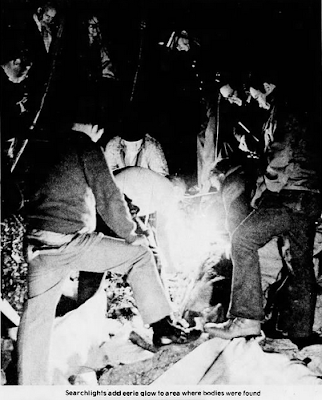
Dannenbaum pocketed the ring, not giving it much thought, until carpenter Philip Harple pried up a board and made a shocking discovery-- a partial human skeleton in a shallow grave, with a blood-stained silk handkerchief knotted around the neck. Also found in the same spot were the remnants of a woman's shoes and clothing. The bones were turned over to Coroner Ashbridge, and detectives Crawford and Geyer immediately went to work on the case.
By Tuesday, the rest of the skeleton had been unearthed. The coroner's physician, Dr. Sidebotham, examined the bones and pronounced the skeleton to be that of a woman in her late 30s. When it was learned that one of the building's former owners was the notorious Jimmy Logue, the inscription on the inside of the gold ring began to make sense. The remains were identified as those of Johanna Logue by her brother, who recognized her dental fillings, and it was apparent that her husband had murdered her before stealing her diamonds and jewels and disappearing into parts unknown.

The Case Against Logue
Logue's stint in the Eastern Penitentiary after his 1871 conviction was the first and longest of his career, but certainly not his last. In 1883 he was convicted of a robbery in Reading and spent three years locked up in the Berks County Jail, only to be promptly arrested for a grocery store robbery in Philadelphia. For this crime he would spend six more years at Eastern Penitentiary. A few years later he would spent ten months at Moyamensing Prison for a string of house burglaries.
Despite the fact that Logue had a very clear modus operandi which seldom involved violence, his criminal reputation led many to believe that he was a ruthless murderer, including Johanna's brother, Peter Gahan, who relentlessly accused Logue of his sister's slaying. Another accuser was Logue's barber stepson, Alphonso Cutaiar, who claimed that Logue showed up at the North Eleventh Street property on Sunday, February 23, and acted "like a crazy man", demanding to know where his wife was and conducting a search of the property which Cutaiar found a little too melodramatic to be believable. Cutaiar also told detectives that he had tried to help Logue many times over the years, hoping that he could convince his stepfather to abandon his lawbreaking ways. "I always thought he was sort of insane," he added.
But the witness whose story cast Logue in the most suspicious light was a neighbor, Mrs. Mary Ann Friend, who resided at 988 Marshall Street. Mary Ann, who was believed to be the last person to see Johanna alive, claimed that she frequently provided shelter to Johanna after her frequent quarrels with her husband, who was said to be extremely jealous of his much younger and attractive wife. He often accused Johanna of carrying on an affair with Peter Burns, another accomplished burglar who would eventually meet his demise inside an Italian prison. According to Mrs. Friend, Jimmy Logue would often threaten to kill Johanna whenever he was drunk.
Logue Turns Himself In
After the identification of the skeleton, the search for Jimmy Logue stretched across the entire country, with dozens of police departments and detective agencies attempting to track down the elusive "King of Sneak-Thieves", who had earned his nickname as a nimble, young burglar who shinnied up drainpipes and leaped across rooftops to carry out his felonious capers. But Logue was now pushing 60, hobbled by age and a lifetime of hard drinking, and yet the authorities could find neither hide nor hair of the notorious bandit.
And then, on March 5, 1895, Coroner Ashbridge received word from his housekeeper that an elderly man had stopped by the house to have a word with him, claiming that it was a matter of high importance and that he would come back at eleven o'clock. The coroner waited, and at exactly eleven o'clock the doorbell rang. The visitor was none other than the king of thieves himself.
"I'm Jimmy Logue," stated the well-dressed man standing on the coroner's doorstep, "whom I believe you want for murder." Logue said that he was tired of running and wanted to give himself up, and Coroner Ashbridge escorted the old man to the 12th District Station House, where Logue was put into a cell. When he finally got to speak with Captain Miller, he told a remarkable tale about drifting to Chicago after his release from Eastern Penitentiary, where he was robbed of all his money. It was here he learned that he was wanted for his wife's murder. But he claimed that he was too broke to turn himself in.
"A young fellow who knew me met me on the street and told me all about it," he said. "That was six months ago. It was the first time I had ever dreamed of such a thing and I made up my mind at once to come back and face the music. But I was broke and I didn't want to come home without a stake. I actually worked on a farm, hoeing broom corn to get cash enough to bring me back." But, as Captain Miller, Coroner Ashbridge and Detective Geyer soon found out, Jimmy Logue couldn't provide any actual details about the time or the manner of his wife's death.

Logue Exonerated
After reviewing all the details of the case, it became clear to authorities that Logue couldn't have possibly murdered Johanna, because he was in Boston with a partner named Mason at the time the killing was believed to have taken place. As it turned out, Logue-- who really had lost all his money-- realized he was too old and feeble to return to his wild ways, and he had no other means to support himself, and so he decided to take the rap for a murder he did not commit. Based on the facts, the only other persons who could've carried out the fiendish crime was Logue's stepson, Alphonso Cutaiar, or the two barbers who worked for him.
Harry Fricke was questioned on March 26, and admitted to smelling a foul stench emanating from the kitchen of 1250 North Eleventh Street not long after Johanna's disappearance. At the time, he thought the smell was coming from the outhouse. But after the skeleton was found under the floorboards 14 years later, Cutaiar tracked down his former apprentice and asked him what he thought about the matter. Cutaiar seemed uneasy, noted Fricke. A few days after being questioned by Coroner Ashbridge and Detective Geyer, Fricke went completely insane and was committed to an asylum. Oddly, one of the attendants at the asylum was Alphonso Cutaiar's father.
Cutaiar was now the leading suspect and he was arrested on April 12 after detectives traced some of the jewelry in his possession to Johanna Logue. Their investigation also revealed that Cutaiar, who had run his barbershop into the ground, bounced around from job to job after he put down his scissors, unable to support himself financially. At one time he had been employed by the Prudential Insurance Company, where he put in a bogus claim on Logue's son, Percy, who wasn't even dead. On April 17, Cutaiar confessed to tying Johanna to a bed-- not in order to steal her jewels, but to save her from Jimmy Logue.
Cutaiar's Statement
"On the night of February 22nd I went back in the kitchen and found Johanna drunk," he stated from his cell at Central Station. "I feared that if she went back to New York, Logue would beat and abuse her. I carried her upstairs and put her to bed, with her clothes on, and then tied her feet with a handkerchief and her hands with a clothesline. I also wrapped the clothesline around her body. I went downstairs to finish up the night's work, and when I came back I found Johanna had rolled over on her face. She was dead, having been smothered under the bolster.
"I was going to tell about the thing the next day but I was afraid, so I waited until Logue came home," he continued. "It was Logue that suggested we put the body under the floor. Logue took her watch and jewelry."
But when confronted with the fact that detectives had traced the stolen jewelry back to him, Cutaiar grew deathly pale and finally admitted that his stepfather had nothing to do with the crime.

The Trial of Alphonso Cutaiar
On Wednesday, May 1, 1895, Alphonso Cutaiar was committed to Moyamensing Prison after a coroner's jury found him responsible for the death of Johanna Logue. He was arraigned before Judge Arnold on June 19 and entered a plea of not guilty. His attorneys, Frank Wagenknight and Hampton L. Carson, immediately put forth a motion for a continuance, which was granted by Judge Arnold. Subsequent requests to delay the trial were also granted.
When Cutaiar's trial finally opened on May 26, 1896 before Judge Harman Yerkes, it was quite a spectacle, as scores of Philadelphians eagerly awaited the testimony of Jimmy Logue, who was, by this time, a living legend of the criminal underworld. Logue, sitting alongside his attorney, Everett Schofield, watched the proceedings with intense interest, even as the bones of his late wife were produced from a box by District Attorney George S. Graham and handed to witnesses to examine. When Logue was called to testify, he told of the great lengths he had gone to attempting to find his missing wife.
"I had the (serial) number of her watch, and engaged the police of different cities to hunt for her," he explained. "While in Denver I telegraphed Cutaiar to known if she had returned and he never answered that telegram. I spent $20,000 in searching for her." Logue then returned to Philadelphia and confronted his stepson after discovering that one of the $1,000 government bonds he had given to Johanna immediately before her disappearance was missing from the house.
"Cutaiar threw his arms around my neck and cried, "I took it!'" testified Logue. "He said he spent the premium and gave the rest to Sallie-- that was the girl whom he married." Logue said that his stepson retrieved what remained of the money from Sallie and gave it back to him. At this point, the district attorney handed Logue the skull and jawbone of his wife. The infamous burglar stared quizzically at Johanna's jawbone with tears in his eyes as he held it in his hands, but admitted that he could not say for certain that the teeth were those of his dead wife.
District Attorney Graham then entered into evidence the confession which Alphonso Cutaiar had given to Detective Geyer and Coroner Ashbridge at Central Station, over defense attorney Carson's objection that the confession had been given under duress. The objection was overruled by Judge Yerkes.
Despite the sensational nature of the case-- and a feeble attempt by the defense to discredit the defendant's confession-- the trial wrapped up quickly, with the jury retiring on the morning of May 29 to ponder the verdict. The jury returned at six o'clock that evening, having found Alphonso Cutaiar guilty of murder in the first degree. The defendant displayed no emotion as the verdict was read.
After the trial, Logue told reporters that he felt sorry for his stepson, whom he had known since infancy. Alphonso had always held a place in his heart, though Logue stopped short of forgiving him. He also told reporters that he planned to have Johanna's remains buried at Woodlands Cemetery-- though this would not happen. Logue, as it turned out, had other plans for his wife's bones.
The Fates of Cutaiar and Logue
Cutaiar was sentenced to death, though his sentence was commuted the following year to life imprisonment at Eastern Penitentiary. He was pardoned in 1912 by Governor Tener, after Cutaiar's supporters convinced the Board of Pardons that the Commonwealth had failed to prove his guilt beyond a reasonable doubt. Upon his release, he moved to North 46th Street and later relocated to Delaware County, where he died on January 25, 1940, at the age of 80.
As for James "Jimmy" Logue, his health, as well as his finances, began to deteriorate soon after his stepson's murder trial. In August of 1899, penniless and with nowhere else to turn, he was admitted to the Blockley Almshouse. He soon grew restless, however, and moved in with a friend, fellow burglar Frank H. Starr, at the House of Industry-- a homeless shelter founded by the Philadelphia Society for the Employment and Instruction of the Poor. On September 29, 1899, Logue's health had deteriorated to such a point that he was transferred to the Philadelphia Hospital. He would never set foot outside again.
 |
| Philadelphia Times, Oct. 1, 1899 |
As Logue lay in a hospital bed on the brink of death, the legendary burglar was exposed-- not as a cold-hearted outlaw, but as a real-life Robin Hood who had given most of his ill-gotten fortune away. According to his lifelong friend, Frank Starr, there never lived a gentler and kinder criminal than Jimmy Logue. "His great fortune, amounting to almost a million dollars, was spent for charitable purposes and to further the interests of his friends," explained Starr.
"Once, down in Richmond, he, with three of his pals, had to make a sudden and discreet departure. In money the quartette had among them only eight dollars. On the road from town they met a poor negro, who told his misfortunes to three of the party, who went back a little way to get a few cents to buy the man some provisions. Logue himself had a talk with the negro, and when he came back there were tears in his eyes. 'How much did you give him?' asked his companions. 'Why, all of it, of course,' answered the burglar.
"I have known him to stop bare-footed children on the street, take them into a store and buy them shoes and other necessary clothing," continued Starr. "The best part of all his charity was that nobody ever knew of it."
Logue, of course, downplayed the praise of his friends and defenders as his days among the living were drawing to a close. "Yes, I suppose I could tell you how I used to spend my money, but you would not believe me, and those who I helped would deny it," he said to the Philadelphia Inquirer just weeks before his death. "I am not looking for any credit because I don't deserve any. I used to feel more than paid when they would say 'God bless you, Jimmy'... You see, everyone likes to be well thought of and have friends, and I used to buy mine, knowing at the time that they would never stay by me, but I was more willing to pay for even an artificial friendship than to have none at all."
Jimmy Logue, who had developed a cold in early September, died at the age of 62 at the city charity hospital at four o'clock on the afternoon of October 4, with his cause of death listed as pulmonary edema. He was buried at St. James' Churchyard in West Philadelphia. Johanna's bones, which had remained in the possession of the coroner's office since their discovery in 1893, were placed inside Logue's coffin as his final request.
Sources:
Philadelphia Evening Telegraph, Oct. 13, 1870.
Philadelphia Evening Telegraph, May 21, 1871.
Philadelphia Times, Nov. 7, 1879
Philadelphia Times, Oct. 18, 1893.
Philadelphia Inquirer, Oct. 19, 1893.
Philadelphia Times, Oct. 20, 1893.
Philadelphia Inquirer, March 7, 1895.
Philadelphia Inquirer, April 19, 1896.
Philadelphia Times, April 26, 1895.
Philadelphia Inquirer, April 29, 1895.
Philadelphia Inquirer, May 2, 1895.
Philadelphia Times, June 20, 1895.
Philadelphia Inquirer, May 28, 1896.
Philadelphia Inquirer, Aug. 6, 1899.
Philadelphia Times, Oct. 1, 1899.
Philadelphia Times, Oct. 13, 1899.
Philadelphia Inquirer, Feb. 22, 1922.

Her brother identified her by the fillings. OK, then.
ReplyDelete